Diese Seite befindet sich aktuell im Aufbau.
Im Rahmen eines NWLS-Projekts am Institut für Angewandte Trainingswissenschaft entsteht ein Orientierungsrahmen für eine ganzheitliche Athlet*innenentwicklung. Im Hintergrund werden bereits fortlaufend Inhalte erarbeitet, von denen einzelne Bereiche schon sichtbar sein können. Die vollständige Bereitstellung der Inhalte ist jedoch erst zum Abschluss des Projekts bis Ende 2026 vorgesehen.
Druck, Fokus und Selbstbestimmung
- Druckresistenz, Fokus und Emotionsregulation unter Weltklassebedingungen⁶⁸
- Umgang mit Reisebelastungen, Zeitdruck und wettkampfdichter Saison⁸
- Selbstbestimmte Karrieregestaltung: eigene Ziele und Grenzen kennen²
- Vorbereitung auf perspektivische Karrieretransitionen⁹¹⁰
Infografik: Mentale Erschöpfung
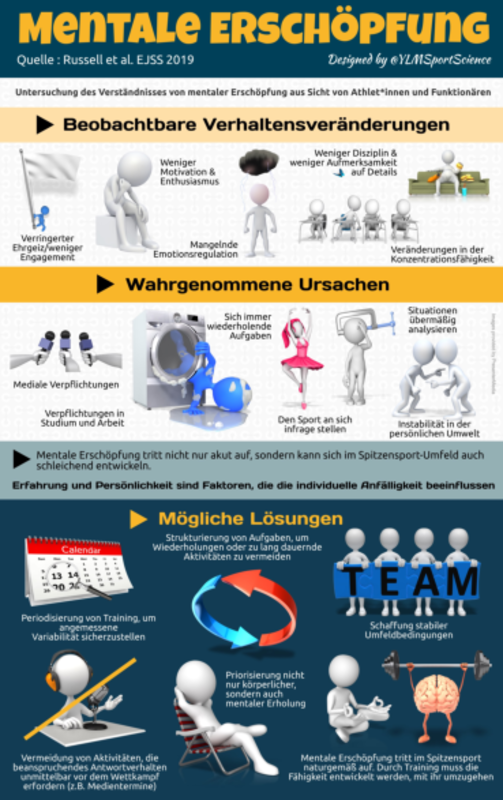
→ Infografik: Mentale Erschöpfung
Reisestress, Wettkampfdichte und öffentlicher Druck machen mentale Erschöpfung in E1–E2 zu einem zentralen Präventionsthema.
Handlungsempfehlungen
- Fördere die Entwicklung ganzheitlich: physisch, psychosozial und psychologisch
Referenzen
² Deci, E.L. & Ryan, R.M. (2000). Self-determination theory and the facilitation of intrinsic motivation, social development, and well-being. American Psychologist, 55(1), 68–78.
⁶ Birrer, D. & Morgan, G. (2010). Psychological skills training as a way to enhance an athlete's performance in high-intensity sports. Scandinavian Journal of Medicine & Science in Sports, 20(Suppl 2), 78–87..
⁸ Reardon, C.L. et al. (2019). Mental health in elite athletes: IOC consensus statement. British Journal of Sports Medicine, 53(11), 667–699.
⁹ Wylleman, P. & Lavallee, D. (2004). A developmental perspective on transitions faced by athletes. In M.R. Weiss (Hrsg.), Developmental sport and exercise psychology (S. 507–527). Fitness Information Technology.
¹⁰ Stambulova, N. et al. (2009). ISSP position stand: Career development and transitions of athletes. International Journal of Sport and Exercise Psychology, 7(4), 395–412.